

Why visibility is no longer
the same as influence.
As media becomes increasingly fragmented, many luxury brands are investing more in marketing while becoming less culturally relevant. This article explores why visibility alone is no longer enough - and why influence, relevance, and cultural resonance have become the true drivers of desirability.
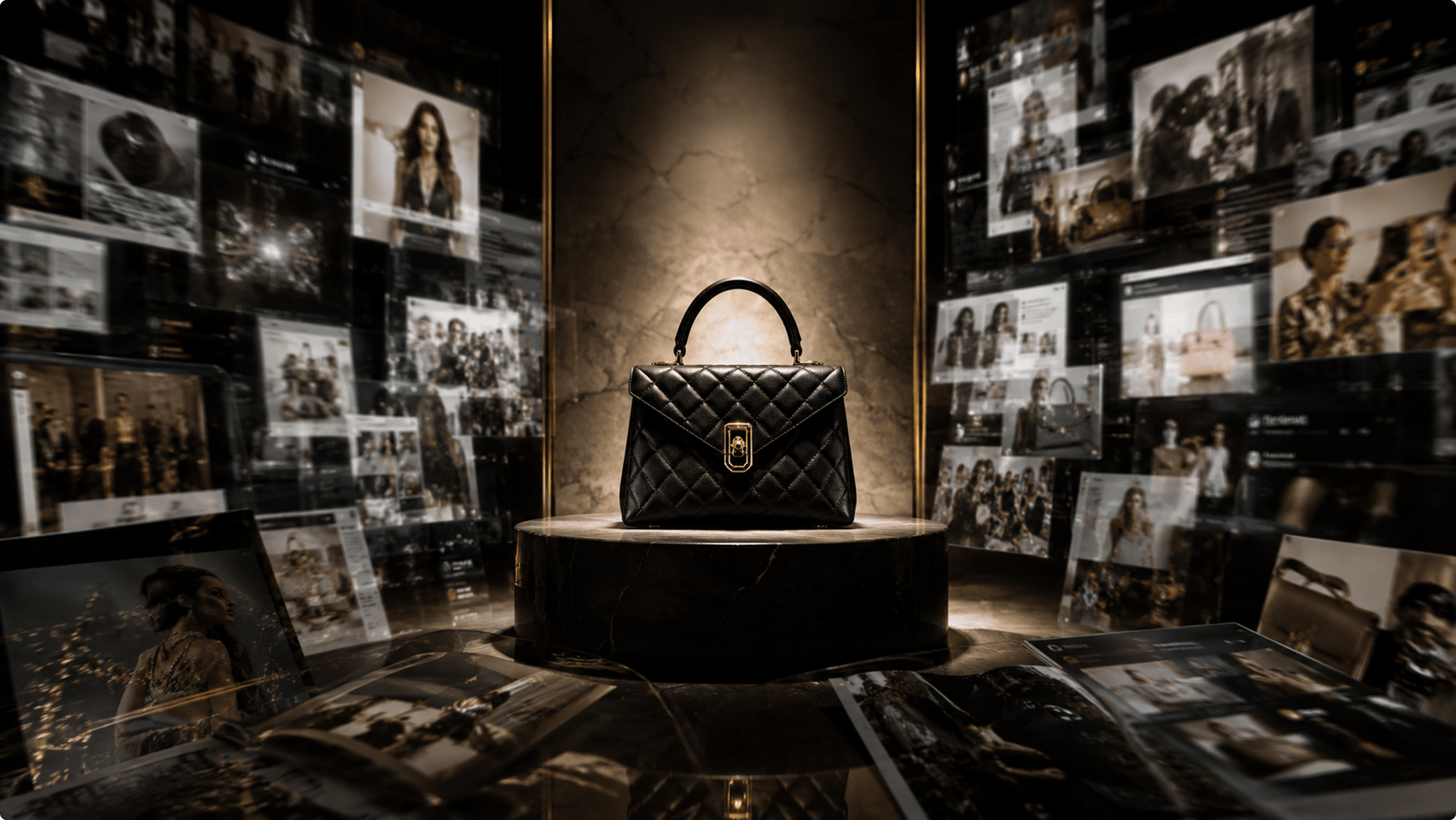
Luxury has never been more visible. It fills social feeds, airport corridors, city facades, fashion-week livestreams, celebrity wardrobes, creator content, flagship-store districts, and increasingly, the algorithmic spaces where taste is discovered, copied, judged, and reassembled.
And yet, for many luxury brands, visibility is not translating into influence.
This is the paradox at the heart of luxury today: brands are spending more energy being seen while struggling to be felt. They are present everywhere, but not always meaningful anywhere. In a media environment defined by fragmentation, abundance, and speed, the traditional luxury formula - high awareness, high price, high control - is no longer enough to sustain desirability.
The issue is not that luxury brands lack marketing. The issue is that marketing has become too easy to mistake for relevance.
Bain & Company and Fondazione Altagamma estimate that global luxury spending reached €1.44 trillion in 2025, representing a marginal year-on-year decline of 1% to 3% at current exchange rates, and roughly flat performance at constant exchange rates.1 In other words, the luxury market is not disappearing; it is recalibrating. Growth is no longer automatic, and the cultural confidence that carried the sector through the post-pandemic boom is being tested.
McKinsey's analysis of the luxury sector is even more direct: price increases accounted for more than 80% of industry growth in recent years, while volume growth was more moderate. The same report notes that rapid expansion has contributed to overexposure, weakening luxury's traditional promise of exclusivity, creativity, and craftsmanship.2
That is the real warning. Luxury is not simply facing a demand problem. It is facing a meaning problem.
THE OLD VISIBILITY MODEL IS BREAKING
For decades, luxury influence depended on controlled distance. A brand did not need to explain itself to everyone. It needed to be recognized by the right people, desired by more people, and accessed by very few. Visibility was carefully staged: the campaign, the runway, the boutique, the magazine, the ambassador, the object.
That model was built for a slower media world.
Today, visibility is cheap, constant, and unstable. Digital video is expected to capture nearly 60% of all U.S. TV and video ad spend in 2025, up from 29% in 2020, according to the IAB.3 That shift shows how quickly attention has migrated into more fragmented, measurable, and platform-specific environments.
More channels mean more opportunities to appear. But they also mean more opportunities to be ignored.
A luxury brand can now launch a campaign across Instagram, TikTok, YouTube, connected TV, paid search, outdoor, retail media, fashion press, celebrity seeding, and influencer partnerships - and still fail to create a cultural moment. The media plan can be perfect while the brand idea is forgettable.
This is why visibility and influence have separated.
Visibility is exposure. Influence is consequence.
Visibility asks: did people see us?
Influence asks: did we change what people desire, discuss, imitate, remember, or aspire to?
Luxury has traditionally been an influence business. Its power has never come only from product utility. It comes from symbolic value: status, taste, identity, belonging, craftsmanship, rarity, cultural intelligence, and emotional projection. When luxury loses symbolic force, it can still be visible - but it becomes easier to question.
MORE MARKETING CANNOT FIX WEAKER MEANING
The instinctive response to slowing momentum is often to market harder: bigger campaigns, louder ambassadors, more collaborations, more drops, more content, more paid amplification.
But if the underlying brand meaning is unclear, marketing does not solve the problem. It accelerates the confusion.
Richemont's 2025 results show how communication remains a major investment area in luxury: communication expenses grew by 4% and amounted to 9.8% of sales.4 That is not a criticism of spend; luxury requires investment in storytelling, image, and desire. But it does highlight a broader truth: spending on visibility is only valuable when it reinforces a brand's relevance.
The challenge is that many luxury brands are operating in a cultural landscape where attention is no longer scarce, but trust, meaning, and distinctiveness are.
Kantar's Media Reactions 2025 found that 57% of consumers express a positive attitude toward ads in general, and 66% feel ads are more integrated within campaigns than before.5 That suggests the problem is not simply that people hate advertising. The deeper challenge is whether advertising is building anything distinctive enough to matter.
In luxury, sameness is especially dangerous.
When every brand uses the same codes - cinematic campaign films, global ambassadors, minimal typography, archival references, curated “intimacy,” influencer dinners, art-world adjacency, quiet-luxury language - the result is not refinement. It is cultural flattening.
The brand may still look expensive. But expensive is not the same as desirable.
RELEVANCE IS NOW PART OF THE LUXURY VALUE EQUATION
Luxury has always justified its price through more than material value. A bag, watch, fragrance, or garment becomes luxury when the object carries meaning beyond its function. The consumer is not only buying leather, metal, fabric, or scent. They are buying a story about who they are - or who they want to become.
That story is becoming harder to sustain through heritage alone.
Bain's 2025 luxury study notes that the global active luxury client base has continued to contract, with about 20 million consumers exiting the market in 2025. The same report observes that, among Gen Z consumers, some brands have successfully connected with evolving ideas of purpose and identity, while others have struggled to keep the cohort engaged.1
This is one of the most important shifts in luxury. Younger consumers are not necessarily rejecting luxury. They are questioning lazy luxury: inflated prices without innovation, heritage without imagination, exclusivity without cultural energy, and visibility without substance.
For a new generation, status is less fixed. It is negotiated through taste, access, values, knowledge, community, and cultural fluency. A luxury purchase must still feel exceptional, but “exceptional” is no longer defined only by logo recognition or price. It is defined by whether the brand feels alive in the world the consumer actually inhabits.
That is why cultural relevance has become a commercial asset.
Edelman's 2025 Brand Trust report found that 73% of people say their trust in a brand would increase if it authentically reflected today's culture.6 For luxury, that should be read carefully. Cultural relevance does not mean chasing every trend. It means understanding the emotional, aesthetic, and social climate around the consumer - and knowing how the brand can contribute to it with authority.
THE DIFFERENCE BETWEEN BEING SEEN AND BEING SIGNIFICANT
A visible luxury brand can dominate paid media.
A relevant luxury brand earns interpretation.
People discuss it. They decode it. They argue about it. They place it inside their own identity. They reference it without being prompted. They recognize its codes even when the logo is absent. They believe the brand has a point of view beyond the campaign.
That is the difference between awareness and cultural resonance.
Kantar's work on brand growth emphasizes that strong brands need to be meaningful, different, and salient. In luxury specifically, Kantar argues that this combination supports both timeless brand reputation and timely cultural influence.7
This is where many brands become trapped. They optimize for salience - being noticed - without building enough meaning or difference.
They are famous, but interchangeable.
Polished, but predictable.
Premium, but emotionally distant.
Everywhere, but not culturally necessary.
Relevance begins when a brand has a role people understand.
Not a slogan. A role.
A house can stand for craft radicalism, creative rebellion, sensual minimalism, intellectual elegance, modern femininity, sport as status, coded restraint, theatrical excess, or regional cultural pride. The role must be specific enough to be recognizable and elastic enough to evolve.
When that role is clear, marketing compounds. Every campaign, store, collaboration, ambassador, product, event, and editorial gesture adds to the same cultural memory.
When that role is unclear, marketing fragments. Every activation becomes another isolated attempt to generate attention.
LUXURY NEEDS CULTURAL FLUENCY, NOT CONSTANT NOISE
The answer is not for luxury brands to become less visible. Visibility still matters. But visibility must serve a deeper system of influence.
That system has several parts.
First, luxury brands need product credibility. Cultural relevance cannot compensate for weak product value. If consumers feel prices have risen faster than creativity, quality, or experience, the brand's symbolic power weakens.
Second, they need a sharper point of view. The strongest brands are not merely present in culture; they interpret culture. They make choices. They edit. They exclude. They show taste.
Third, they need community proximity. Influence increasingly comes from smaller, more trusted spaces: niche creators, local scenes, collectors, stylists, editors, subcultures, private clients, and peer-to-peer recommendation. Mass visibility may introduce the brand, but cultural credibility is often built in narrower circles.
Fourth, they need experiential depth. McKinsey notes that luxury clients are becoming more interested in experiences, not only goods, and that brands must exceed higher client expectations to win spend against luxury travel, wellness, and other premium categories.2
Finally, they need consistency. Relevance is not a one-season campaign. It is the accumulated effect of a brand repeatedly showing up with clarity, taste, and conviction.
This is where luxury has an advantage. Few categories have richer archives, stronger craft traditions, more distinctive visual codes, or deeper emotional mythology. The problem is not a lack of material. The problem is often a lack of translation.
The question is no longer: how do we make people see the brand?
The better question is: how do we make the brand matter now?
THE FUTURE BELONGS TO CULTURALLY LEGIBLE LUXURY
Luxury's next era will not be won by the brands that shout the loudest. It will be won by the brands that are most culturally legible.
Legibility does not mean simplicity. It means people understand what the brand stands for, why it exists, what world it belongs to, and why its products deserve attention beyond price.
In a fragmented media world, influence is not achieved by appearing everywhere. It is achieved by creating meaning that travels.
The most desirable brands will still invest in marketing. But they will treat marketing as the expression of relevance, not the substitute for it. They will measure more than reach. They will look at resonance, trust, community energy, cultural adoption, earned conversation, and the strength of their own codes.
Luxury does not have a marketing problem.
It has a relevance problem.
And the brands that solve it will not simply be more visible.
They will become more necessary.
REFERENCES & SOURCES:
- Bain & Company and Fondazione Altagamma, Finding a New Longevity for Luxury, 24th edition of the Luxury Goods Worldwide Market Study, including 2025 estimates for global luxury spending, personal luxury goods performance, consumer-base contraction, and Gen Z engagement. https://www.bain.com/insights/finding-a-new-longevity-for-luxury/;
- McKinsey & Company and The Business of Fashion, The State of Luxury Goods in 2025, including analysis of price-led growth, overexposure, weakened exclusivity, and the shift toward luxury experiences. https://www.mckinsey.com/industries/retail/our-insights/state-of-luxury;
- Interactive Advertising Bureau, 2025 Digital Video Ad Spend & Strategy Report: Part One, including the forecast that digital video would capture nearly 60% of U.S. TV/video ad spend in 2025. https://www.iab.com/insights/video-ad-spend-report-2025-part-one/;
- Richemont, Results for the Year Ended 31 March 2025, including communication expenses as 9.8% of sales. https://www.richemont.com/news-media/press-releases-news/richemont-posts-robust-performance-for-the-year-ended-31-march-2025/;
- Kantar, Media Reactions 2025: Where Do People Prefer Advertising?, including findings on consumer receptivity toward advertising and perceived campaign integration. https://www.kantar.com/north-america/inspiration/advertising-media/media-reactions-2025-where-do-people-prefer-advertising;
- Edelman, 2025 Edelman Trust Barometer Special Report: Brand Trust, From We to Me, including findings on cultural relevance and brand trust. https://www.edelman.com/trust/2025/trust-barometer/special-report-brands;
- Kantar, Meaningful Difference: The Strategic Growth Driver Behind Iconic Brands, including its framework of meaningful, different, and salient brand qualities in luxury. https://www.kantar.com/inspiration/brands/meaningful-difference-the-strategic-growth-driver-behind-iconic-brands