

The Rise of Thai Influence
in Milan and Paris.
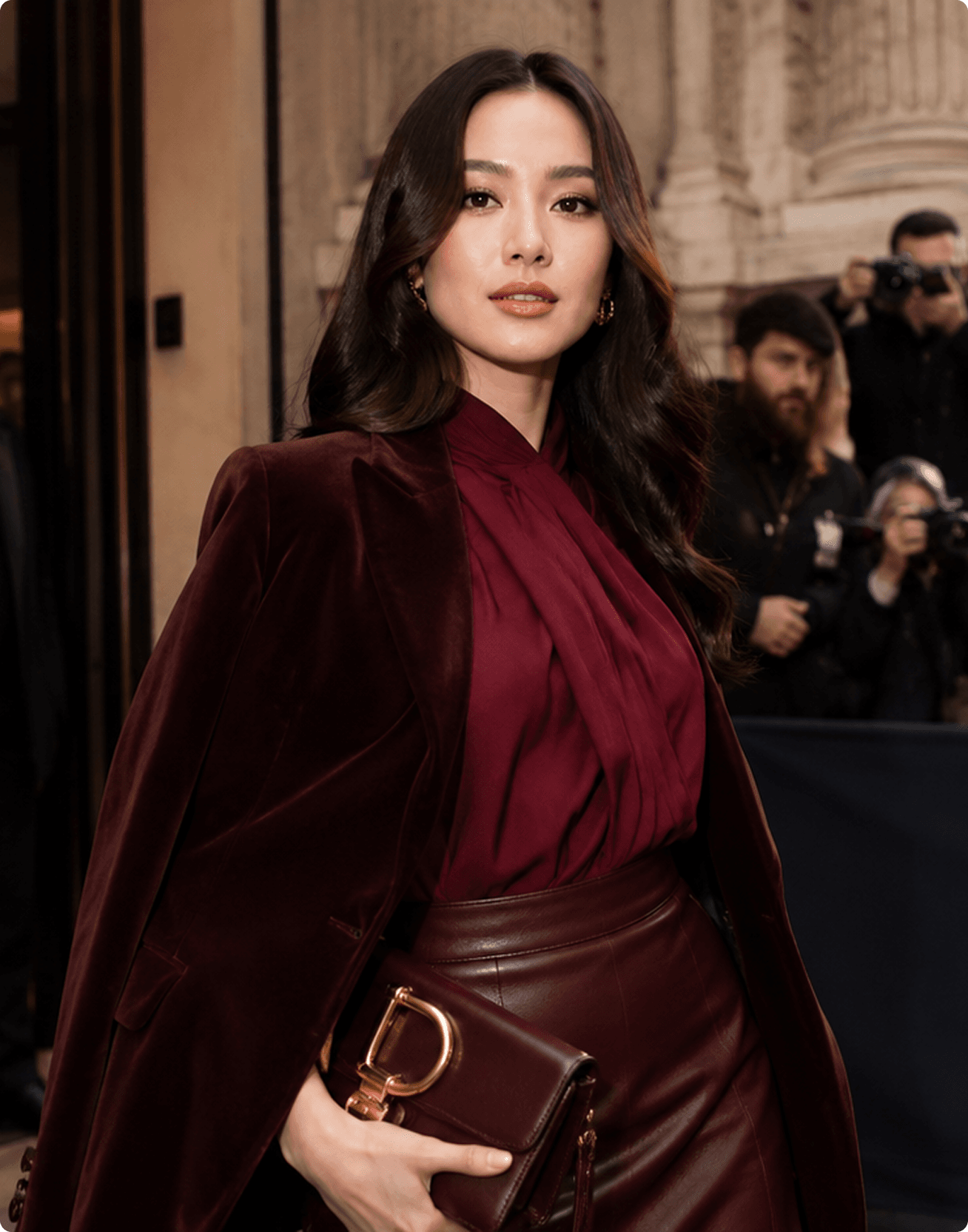
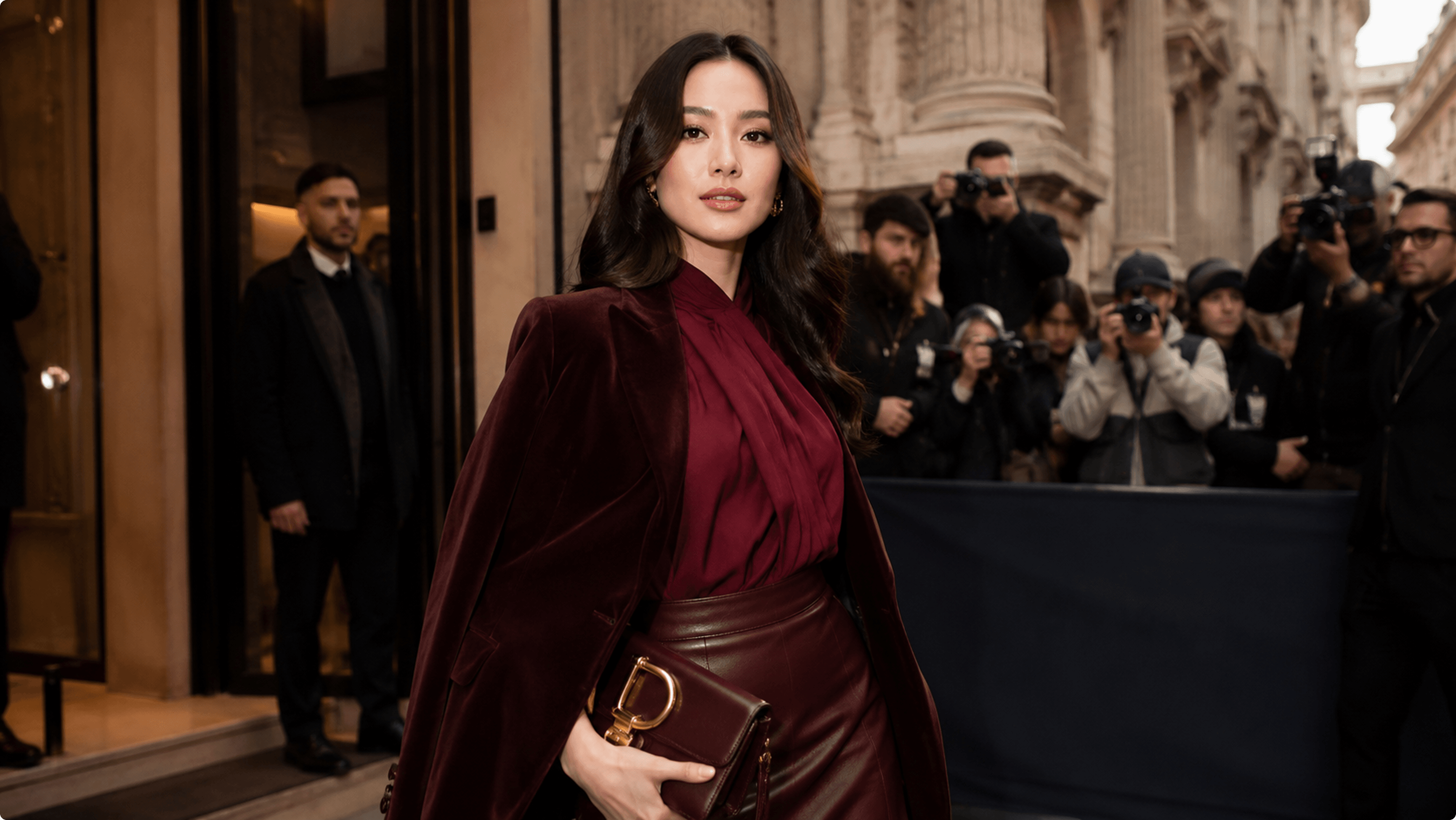
When the earned-media rankings landed at the close of Milan Fashion Week’s Fall/Winter 2026 season, the three guests who had generated the most value for the entire week were all Thai — led by Faye Peraya, attending the Ferragamo show for the first time, whose presence alone was worth 11.1 million US dollars in earned media.1 A decade ago, a Thai name topping a Milan media ranking would have been a curiosity. Today it is a pattern — and the clearest signal yet of a bet that the world’s biggest luxury houses are now placing, deliberately and at scale, on Thailand.
That bet has two halves. The first is on Thai faces — the actors, idols and creators who command some of the most engaged fan communities on earth. The second, quieter and more consequential, is on the Thai market itself. This essay is about why luxury has concluded that both are worth the wager, and why the front rows of Milan and Paris turned out to be only the visible edge of a far larger shift.
01 THE SURGE NOBODY IN FASHION CAN IGNORE
Begin with the surface, because it is impossible to miss. Between 2023 and 2024, the number of Thai celebrities attending fashion weeks around the world rose by 225%.2 At a recent Paris season, Thai (and Filipino) celebrities surpassed even K-pop idols in average media impact per appearance.3 At Milan this year the top three media-value guests were all Thai; at Dior, two Thai stars alone generated close to half of the entire house’s media value for the week;4 and across one recent season the Asia-Pacific region accounted for roughly 74% of all earned media value produced at the shows.5 The front rows that once measured their pull in Hollywood A-listers now run, in significant part, on Thai star power.
The currency of all this is earned media value — the analytics industry’s estimate of what a brand would otherwise have had to pay to buy the visibility it received for free.6 By that measure, Thai talent has become some of the most valuable real estate in fashion.
02 THE CASE FOR THE BET: SOFT POWER
None of this is an accident of fashion; it is the dividend of a deliberate cultural strategy. Over the past decade Thailand’s entertainment industry — its globally adored “Boys’ Love” and “Girls’ Love” dramas, its booming T-pop — has captured audiences far beyond its borders, and the government has moved to harness that reach as national soft power, consciously echoing the South Korean model.7 Luxury noticed early. Thai stars bring three things rivals struggle to match: extraordinarily loyal fan communities, a cultural fluency that lets them speak to Eastern and Western audiences at once, and a return on attention that outperforms far larger markets.6 The numbers bear it out — Thai luxury collaborations generated an estimated 106 million dollars in earned media value in 2023 alone.7
The result has been a courtship. Burberry’s decision to name the actor Bright Vachirawit an ambassador in 2022 was an early, pioneering move;8 since then, houses from Prada to Gucci to Balenciaga have signed Thai talents such as Win Metawin and Davika Hoorne, while Lisa of Blackpink — a Bvlgari ambassador since 2020 — has grown into a creative partner with her own limited-edition pieces.2 The Thai ambassador is no longer a regional add-on; it has become a global asset.
Thailand did not stumble into fashion’s front row. It was invited there by the most engaged fandoms on earth.
03 THE PROOF IN A SINGLE SEAT
What separates a lucrative bet from a wasted one is the precision of the match — and the clearest illustration is the result that opened this essay. Faye Peraya’s first-place finish at Milan was not luck. The pairing of Faye with Ferragamo for Fall/Winter 2026 was the strategic recommendation of Bureau of Wonder, which matched the talent to the house. The eight-figure outcome is what a correct casting decision looks like when it is measured.
Faye herself reflected afterwards that Ferragamo expressed her own identity so well,1 and that authenticity is the mechanism, not a flourish: when the fit between talent and house is genuine, the fandom mobilises with a conviction no budget can buy. The discipline behind Thailand’s rise is exactly this — the cultural translation that turns the right Thai face, in the right house, into a global moment. It is a craft, and it is becoming one of the most valuable services in the industry.
04 THE DEEPER BET: A MARKET, NOT JUST A MUSE
Yet to read all this as a story about borrowing Thai faces for global reach is to miss the larger wager. Thailand is fast becoming one of luxury’s most important growth markets in its own right. Its luxury-goods market is projected to climb from roughly 2.7 billion dollars in 2026 to 3.7 billion by 2031, a 6.6% annual rate, with Bangkok’s two-hundred-plus boutiques across Central Embassy, Siam Paragon and ICONSIAM accounting for more than half of national sales.9 The capital is in the middle of a luxury building boom, anchored by the 3.9-billion-dollar One Bangkok development, while the country’s ultra-wealthy population is forecast to grow nearly 15% by 2028 — enough, by some estimates, for Thailand to overtake Singapore as South-East Asia’s dominant luxury player.2
This is the logic that ties the two halves of the bet together. Before the pandemic, Thai shoppers largely bought their luxury abroad; as brands deepened their domestic presence and clients stayed home, the houses began tapping Thai stars expressly to win the Thai consumer — and found that the same faces unlocked the wider Asian market too.9 The ambassador strategy and the market strategy are, in the end, the same strategy: meet rising Thai demand at home, and ride Thai cultural influence across the region.10
The same faces that win Milan’s front row are the ones winning Bangkok’s shop floor.
05 THE CAVEAT — AND THE THROUGH-LINE
A note of discipline is warranted. Earned media value measures buzz and volume, not editorial prestige or sales, and a brand that chases the metric alone risks tokenism — treating Thai talent as a quick spike rather than a genuine partnership. The houses getting it right are building the deeper, creative relationships that endure, of which Lisa’s evolution at Bvlgari is the template.2 But the caveat only underscores the conclusion. Thailand’s ascent is not a fashion-week novelty or a passing trend; it is a structural shift in where cultural desire is manufactured. The smart money spotted it first in the front row. It is now moving, decisively, to the shop floor — and the brands betting on Thailand today are not chasing a moment. They are recognising a new centre of gravity.
REFERENCES & SOURCES:
- ELLE Thailand — Milan Fashion Week FW26 earned-media ranking: the top three guests were all Thai, led by Faye Peraya at Ferragamo with $11.1M EMV (her debut at the show); she reflected that Ferragamo expressed her identity well. March 2026. ellethailand.com
- Al Dente (Paris/New York) — “Why Thailand Is Luxury’s Next Big Bet”: Thai attendance at fashion weeks rose 225% (2023–24); Prada, Gucci and Balenciaga signed Win Metawin, Davika Hoorne and others; Lisa’s Bvlgari creative partnership; the $3.9B One Bangkok; UHNW +14.7% by 2028; Thailand set to overtake Singapore by 2028. aldenteparis.com
- nss magazine (citing Launchmetrics) — at a recent Paris Fashion Week, Thai and Filipino celebrities surpassed the average media impact of K-pop stars; The White Lotus season three, set in Thailand, featured Lisa. nssmag.com
- Influencity (citing Lefty & Karla Otto) — Paris Fashion Week 2026: two Thai stars (Orm and Lingling) alone drove close to half of Dior’s media value for the week. influencity.com
- The Impression — “Fall 2025’s Media Value by the Numbers”: the Asia-Pacific region represented roughly 74% of total EMV (Lefty); Dior’s top three talents, all Asian, generated about $54M. theimpression.com
- Lefty — “Top Thai Influencers of Fashion Weeks”: EMV explained, and the drivers of Thai talent’s outsized value — highly loyal fandoms, cultural fluency across Eastern and Western audiences, and high return relative to market size. lefty.io
- Observer Research Foundation (ORF) — “Thailand’s soft power boom”: BL/GL dramas and pop culture as deliberate national soft power; Thai BL actors courted as ambassadors by Burberry, Prada and Dior; Thai luxury collaborations generated ~$106M EMV in 2023. orfonline.org
- Lefty — “From ‘Boys Love’ to Global Luxury: The Thai Effect”: Burberry’s 2022 appointment of Bright Vachirawit as a pioneering move, and the post-pandemic pivot to courting Thai stars to win the domestic consumer. lefty.io
- Mordor Intelligence — Thailand luxury-goods market: ~$2.72B (2026) rising to ~$3.74B by 2031 at 6.6% CAGR; Bangkok’s 200-plus boutiques (Central Embassy, Siam Paragon, ICONSIAM) account for ~55% of national luxury sales. mordorintelligence.com
- Business of Fashion — “Thailand Is Becoming a Luxury Retail Powerhouse”: global brands sign Thai ambassadors to tap rising local demand and wider-Asia appeal, amid major retail investment from Central Group and others. businessoffashion.com